
The fragile ceasefire in West Asia between the US and Iran to halt the hostilities in the region for two weeks faces renewed uncertainty as Tehran reportedly moved to block the strategic Strait of Hormuz once again due to Israel's intensified offensive against Hezbollah in Lebanon, according to Iranian state media Islamic Republic News Agency (IRNA), which US President Trump says was "not included" as part of the ceasefire deal.

After the Israeli attack on Iran's South Pars Gas Field on Wednesday night, in retaliation, Iran struck Qatar's Ras Laffan Industrial City, resulting in extensive damage, as per the country's Ministry of Defence.

The United States Central Command (CENTCOM) has announced that American forces are maintaining a strict maritime restrictive operation in the region, continuing to enforce a blockade against Iranian ports.

Russian Foreign Minister Sergei Lavrov will visit Beijing to discuss the West Asia conflict, the Strait of Hormuz blockade, and bilateral relations with Chinese leaders.

Indian benchmark equity indices Sensex and Nifty closed higher, recovering from previous losses, driven by a global market rebound, a pause in Israel-Iran hostilities, and a rally in bank stocks.

The targeted eastern area is of immense strategic importance, as it is where the "majority of the country's oil resources are located."

Trump's remarks marks one of the most direct rebukes yet from Washington to its allies over their refusal to support US-led military operations in Iran and over the energy crisis triggered by disruptions in the Persian Gulf.

Former US President Donald Trump claimed victory over Iran, stating they agreed to never have a nuclear weapon and provided a 'significant prize' related to the Strait of Hormuz. He also suggested a change in Iranian leadership and acknowledged Pakistan's role in facilitating talks.

This sharp Iranian response came after a series of uncompromising remarks from the US president.

Iran on Thursday spelled out three conditions to end the war with Israel and the United States, which entered its thirteenth day today. Taking to X, Iran's President Masoud Pezeshkian said he reaffirmed the country's commitment to peace during talks with leaders of Russia and Pakistan.

Saudi Arabia and the UAE are actively pushing Trump to take the war to its bitter finish and 'erase' Iran's presence in the geopolitics of the region. Simply put, the two most powerful Sunni Arab oligarchies are on the same page as Israel. Such interference increases the risk of a breakdown in dialogue between the US and Iran, points out Ambassador M K Bhadrakumar.

United States President Donald Trump has issued a strong warning to Iran, asserting that any attempt to impede the transit of petroleum through the Strait of Hormuz would be met with massive military retaliation.

Former US President Donald Trump has criticised Iran's stance on the Strait of Hormuz, calling it a form of 'extortion' amid ongoing negotiations for a peace deal. The remarks come as Iran considers imposing transit fees on vessels crossing the strategic waterway.

Trump claimed on social media that recent US-Iran discussions were 'very good and productive' and aimed at a 'complete and total resolution' of the conflict.

Reliance Industries Ltd reported a 22 per cent year-on-year decline in consolidated net profit for the June quarter, primarily because the previous year's earnings were inflated by a one-time gain from the sale of its stake in Asian Paints.

The United States and Iran, with regional mediators, are reportedly discussing a potential 45-day ceasefire to prevent further escalation of conflict, including strikes on Iranian infrastructure and retaliation against Gulf states' facilities.

With reference to the news article appearing in a leading financial daily captioned 'IOC, National Iran Oil in stock swap talks', Indian Oil Corporation Ltd has informed BSE that the matter has not yet been finalised and it is too early to comment.

Indian benchmark indices Sensex and Nifty experienced a significant slump in early trade, mirroring a sharp decline in global equities and a fresh spike in crude oil prices, exacerbated by simmering tensions in West Asia and a global unwinding of the AI-led rally. Track how sensex, Nifty fared on June 8.

China has criticised the US blockade of the Strait of Hormuz, calling it a dangerous and irresponsible move, and urged Washington and Tehran to honour the ceasefire. Beijing also denied aiding Iran militarily and threatened countermeasures if the US imposes tariffs.

Brent crude prices surged sharply on Monday, rising by more than 25 per cent to $116.5 per barrel, amid the ongoing conflict in West Asia, which has made crude prices bullish.

India has denied making any payments to Iran to secure safe passage for its vessels through the Strait of Hormuz, following reports that Indian vessels were fired upon in the region.

'The real shock is going to be from a deficient monsoon.'

The Israeli Air Force (IAF) said it struck several targets in Tehran, Shiraz and Ahvaz simultaneously over the past 24 hours, targeting sites linked to Iran's ballistic missile programme, air defence systems and military headquarters.
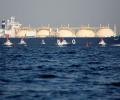
The government has withdrawn most provisions of the emergency natural gas supply regulation order imposed during the West Asia conflict after liquefied natural gas (LNG) shipments through the Strait of Hormuz resumed following a ceasefire.

Chaffing under public ridicule in the US as well as internationally for having 'lost' the war, Trump is under immense pressure to do something, cautions Ambassador M K Bhadrakumar.

Donald Trump's inconsistent statements and actions regarding the conflict with Iran have drawn criticism and confusion, raising questions about American credibility and the direction of US foreign policy.

The ceasefire is still technically holding, to the extent that no overt hostilities have been reported yet, but the rhetoric has hardened dangerously. The week ahead will also clarify whether the Islamabad failure was a negotiating tactic or whether Washington has genuinely locked itself into a position from which the only exits are climb-down, escalation, or the slow bleed of a new status quo that nobody chose and nobody controls. Prem Panicker continues his must read blog on the Iran War.

'Buy on dips, buy on dips and sell on rise.'

His remarks come after Trump warned Iran of severe consequences if it fails to reopen the strategically vital Strait of Hormuz, a key global energy transit route.

US Special Envoy Steve Witkoff and Iranian Foreign Minister Abbas Araghchi are reportedly heading to Switzerland for a new round of US-Iran negotiations, following a recently announced memorandum of understanding to end hostilities in West Asia and a ceasefire between Israel and Hezbollah.

The report said ships must submit full documentation, obtain clearance codes and accept IRGC-escorted passage through a designated corridor.

Gwadar is viewed as a critical pearl in China's maritime strategy as it would give a permanent logistical footprint near an important choke point - the Strait of Hormuz and the oil rich Persian Gulf, explains Commodore Venugopal Menon (retd).

The US Central Command (CENTCOM) confirmed striking the Guinea-Bissau-flagged oil tanker MT Jalveer, carrying 20 Indian seafarers, in the Gulf of Oman for allegedly violating the US blockade against Iran. This incident marks the third commercial vessel attacked by US forces in the region this week, with three Indian seafarers previously losing their lives in an attack on the MT Settebello.

Iran has reportedly allowed select "friendly nations" including India and Pakistan limited access to the Strait of Hormuz amid ongoing conflict, easing some energy supply concerns. Here's what the move means for global trade and oil routes.

US President Donald Trump and Russian President Vladimir Putin discussed the Iran conflict and its impact on global energy supplies during a phone call.

The Trump administration has announced a temporary authorisation for countries to purchase Russian oil stranded at sea, aiming to stabilise global energy markets amid rising oil prices and tensions with Iran.

'Strikes into the Gulf countries are proof that the security guarantees offered by the US are ineffective and that the Gulf countries cannot rely on American security assurances for their safety.'

An Indian national has reportedly been killed in an attack carried out by Iran using a 'suicide' boat against a US-owned oil tanker near Iraq. The incident has raised concerns about the safety of seafarers in the region.

Iran's Islamic Revolutionary Guard Corps (IRGC) claims control of the Strait of Hormuz and reports striking a US destroyer, escalating tensions in the Middle East following retaliatory strikes between Iran, the US, and Israel.

If the oil infrastructure is attacked by the United States, the whole area could be flooded with oil, spilling into the Persian Gulf.
